Our Mission
Who Owns The Flavor is a three-part podcast, with additional written content, that dives into the origin, ownership, and impact of local dishes along the Mississippi. Along the way, our team of journalists from the University of Missouri stopped through St. Louis, Memphis, and New Orleans to get to the bottom of the question — who owns the flavor?
Last summer, as I scouted people and places for this podcast, I slipped into a restaurant in Ocean Springs, Mississippi for a quick lunch. Sitting in the bustling pub, waiting on a catfish Po’ Boy and fries, I heard a familiar melody wafting from a makeshift stage.
“It’s not unusual to be loved by anyone…”
Suddenly, I wasn’t in the Delta anymore. The soulful voice of a 30-something Latino cover musician transported me back in time. I was a boy again, visiting my grandparents on Lumpkin Street on Detroit’s northeast side. My grandmother, beautiful and full-figured with thick wavy silver hair, sat on the sofa, rhythmically tapping her foot, her eyes fixed on the television.
Tom Jones was on!
The way she leaned forward during his performances, that sly grin when he’d wink into camera — I’ll always cherish the memory of watching my grandma melt into a harmless schoolgirl crush over a swaggy white guy in a silk scarf and bell bottoms.
Back then, I had assumed that Tom Jones was American, a hip-thrusting, self-styled Vegas crooner. It wasn’t until years later that I would learn that grandma’s heartthrob was Welsh, a coal miner’s son from Pontypridd whose silky baritone had traveled from European valleys to American living rooms, seducing my gran without regard for borders.
I remember once comparing Tom Jones to soulful Elvis Presley. I was quickly corrected, by friends and family alike. Tom Jones, I learned, enjoyed broader acceptance in certain Black circles than Elvis. Sure, both men built their careers on Black musical foundations — gospel, rhythm and blues, soul. But Jones wore his influences flagrantly; he was unapologetically sexual, gospel-drenched and transparent in his debt to Black performers.
This series is about something larger than those cultural icons. It’s about how communities and industries value its inventors. Is there a market value in ‘authenticity’ or should there be? Who gets to decide when borrowing from a community constitutes theft? In this series, we explore that question not through song, but within foodways along the Mississippi River.
Why Our Investigation Matters
Food carries our stories and connects us to where we come from. As globalization threatens to erase authentic cultural traditions, food protection battles are erupting worldwide, from Mexican tequila brands feuding over agave ingredients, to France’s Champagne industry forcing Miller High Life to destroy beer cans in Belgium for calling itself “the champagne of beers,” to India fighting to protect Basmati rice from being patented by a U.S company.
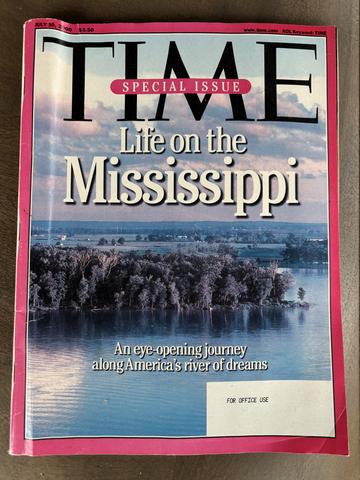
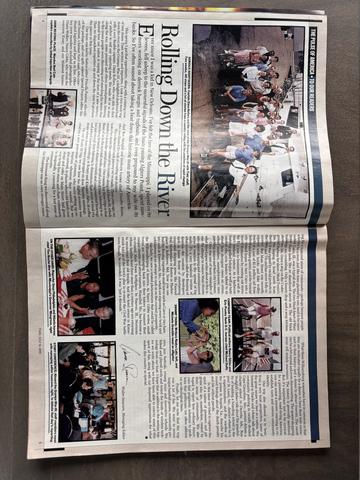
Nearly three decades ago, I worked for Time magazine as Midwest bureau chief. As we approached the 2000 presidential election, then-managing editor Walter Isaacson, a New Orleans native raised on tales of Huck Finn, led us in an ambitious reporting project: telling stories along the Mississippi River that would illuminate the social and political issues framing national debates. Aboard Grandpa Woo, our correspondents discovered a powerful lens on America reporting along the Mighty Mississippi.
Who Owns the Flavor? stays the course — this time through recipes and restaurants. A few weeks ago, our reporting team — seniors at the Missouri School of Journalism in capstone Journ4410 Reporting Projects — rented a Chevrolet Suburban and set out on a three-day, 1,600-mile exploration of a question that defines these divided times: who has the right to profit from culture?
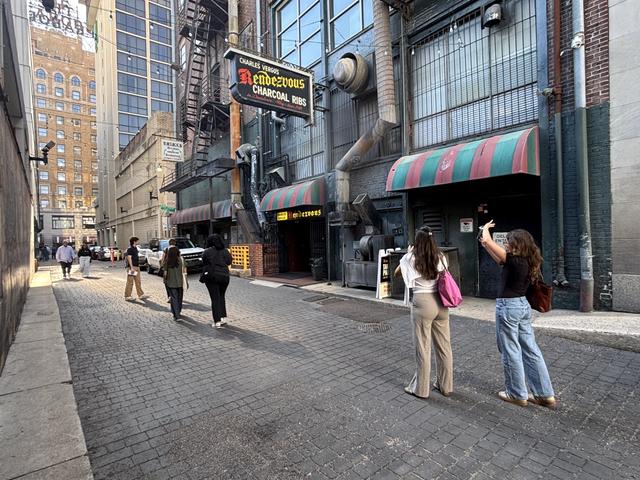
Our whirlwind tour was instructive. In St. Louis, we found community pride and rivalry in the origin story of toasted ravioli; in Memphis, we encountered fierce competition and economic disparity between popular barbecue restaurants like Rendezvous and scrappy crosstown rival, Ballhoggerz; in New Orleans, we learned from award-winning food writer Ian McNulty and legendary creole chef Frank Brigtsen the myriad ways Hurricane Katrina has shaken up cuisine in the Big Easy, for better and worse. A trip highlight: after a panel discussion at historic Dooky Chase Restaurant, Edgar “Dook” Chase IV signed copies of his late grandmother Leah Chase’s memoir and gifted them to us.
At every stop, we came to appreciate food as a unique and powerful economic driver in tourism — and upward mobility. Every taste of toasted raviolo, rack of wet or dry ribs, or beignet carries a people’s history — and policy decision. Every recipe represents generations of lore and refinement — and zoning ordinance. When James Beard famously said “Food is our common ground, a universal experience,” he surely wasn’t talking about profits.
Ron Stodghill
Meet the Team
Ron is an award-winning journalist, author, and professor at the Missouri School of Journalism, where he serves as the Meredith Chair for Service Journalism. A former staff writer for such publications as the New York Times, Business Week and TIME magazine, Ron explores the intersection of business and culture. His current research and teaching project, Who Owns the Flavor?, investigates how taste, tradition, and ownership collide along local and global foodways.
Lola is pursuing a bachelor’s of journalism with an emphasis in writing/reporting and a minor in business on track to graduate from the University of Missouri in May 2026. She is a city/county government reporter for the Columbia Missourian, and has also done work with D Magazine, KDFW Fox 4, CBS Sports and more. While local news is where her focus lies, she most enjoys writing feature and profile stories where she connects with sources on a deeper level.
Tanvi is pursuing a bachelor of arts in art and journalism, with an emphasis in reporting and writing. She’s also getting a minor in French and plans to graduate from the University of Missouri in May 2026. She enjoys writing feature and profile stories and has reported for K-12 education with the Columbia Missourian. She hopes to continue with local reporting after graduation.
Amber is getting ready to graduate with her bachelor’s of journalism in December before transitioning to a full time graduate student in the spring. During her undergraduate studies, Amber had a reporting and writing emphasis and earned a Women and Gender Studies minor. She was a city/county government reporter for the Columbia Missourian and has also reported for the Georgia Recorder. Her masters degree will have a Data and Investigative Journalism focus.
Torryionna is graduating from the University of Missouri this December. She’s pursuing a bachelor’s of journalism with an emphasis in writing and reporting. Torryionna has served as an higher education reporter for the Columbia Missourian focusing on governance and research. After graduation she plans to attend law school to become a constitutional or civil rights attorney.
Paige is graduating from the University of Missouri in December 2025 - so soon! She’s majoring in broadcast journalism and minoring in atmospheric science and plans to be a weather woman! During her time at Mizzou, Paige has been a reporter on KOMU 8 News, a forecaster with ABC17, and a youth leader back at her hometown church. Paige trusts in God’s plan for her, and is excited to see where she ends up!
Sophia is graduating from the University of Missouri in May 2026 with degrees in journalism and sociology, and a certificate in addiction science. She specializes in data and investigative reporting, primarily for radio, and previous beats have included state government, K-12 education and criminal justice. Sophia’s undergraduate sociological research projects have centered on race and weight stigma in healthcare, and sexual cybercrime against the LGBTQ community.
Shane is graduating from the University of Missouri in May 2026 with a degree in journalism and certificate in web development. He is focused on data reporting and developing digital tools for journalists, and has covered higher education, Missouri state government and the EU.